
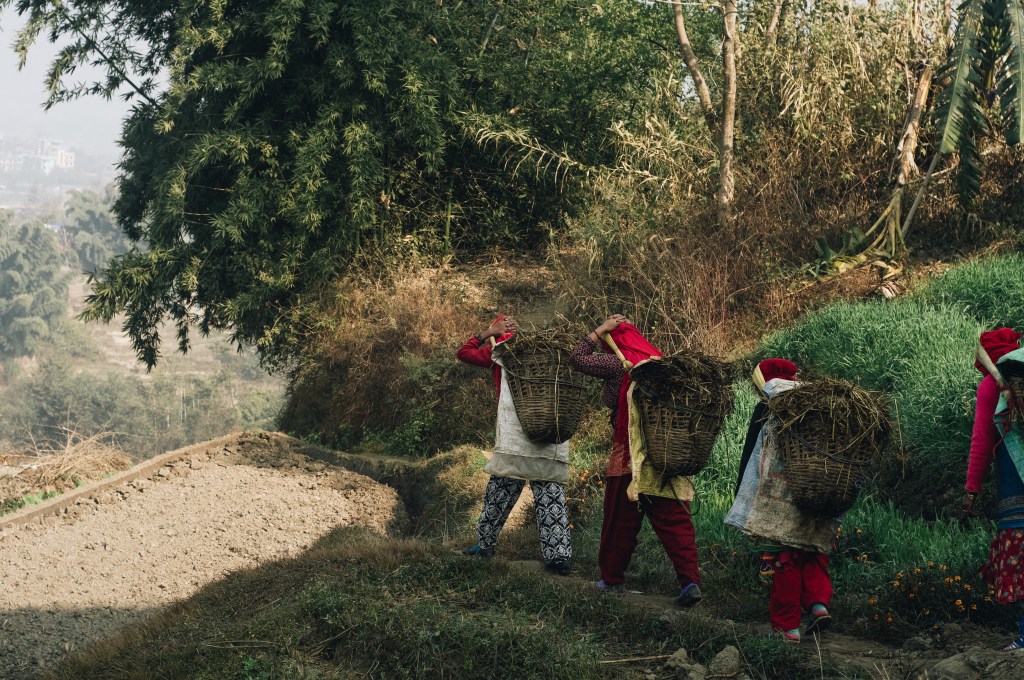
It’s been about three weeks since arriving in Nepal. It’s only obvious and natural to experience culture shock when traveling somewhere new, especially a place so far and different from home.
That’s actually one of my favorite parts about traveling: experiencing the differences that other places have in their daily life operations. The first of such experiences I’ve had here was opening a bathroom door expecting to see a toilet but was kindly greeted by a porcelain squatty potty instead.
But minor day-to-day differences like food, language, traffic and toilets in other countries tends to be more of an endearing, or at worst, once in a lifetime experience to me, than an alarming disapproval in which the term “culture shock” infers.
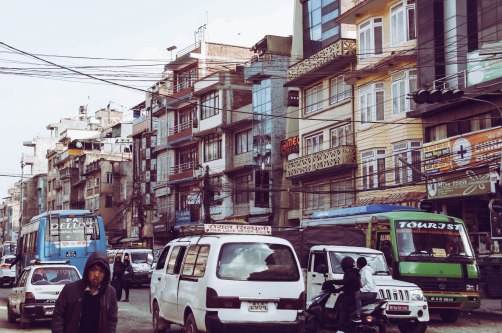
Upon arrival to our bed and breakfast in Kathmandu, we were told we had a scavenger hunt to accomplish, which included tasks, such as: taking a micro van downtown (it’s a common form of public transportation where you literally just jump into a minivan stuffed to the brim with people all going in the same general direction), praying with Buddhist monks, getting a picture of a monkey or cow just wandering the streets, and bargaining with a shop owner over something you wanted to buy.


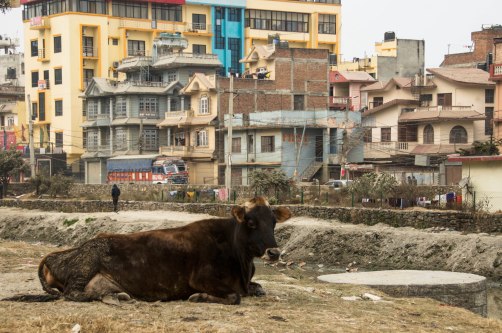
I don’t think I will ever get over the stray cows and monkeys everywhere.
I was immediately enchanted by the chaos of the traffic that somehow seemed to “flow”, despite people weaving in between cars crossing the street, like the game Frogger. The people who so kindly assisted us around the city to make sure we didn’t get lost; the sacred temples and rituals we so casually encountered. The narrow stone streets that were too small for even one car, but somehow squeezed two in opposite directions. The markets with peacock feathers, mandala artwork, bananas, incense, spices, grains, and lots and lots of knock-off North Face products.
I was in cultural heaven, really. I was so enthralled and haven’t felt so in my element or alive in a while. I fell in love with the Nepal that I saw that day. I was on a travel high, despite 48 hours of traveling across the world that immediately preceded the scavenger hunt. Not even the police man that pulled our taxi over, wearing a sweater with a patch that said “Queen” on it, who got in our car and made us late and lose the scavenger hunt, could get me down.
The next day, we were having a guided tour of the city, and I was super excited to get more in-depth information about Kathmandu.
However, it wasn’t a typical touristy tour. It was a social justice tour. Which meant we were going to hear about the dark things that were directly creating inequalities and injustices in the city and the nation. It went into the depths of the exploitation of workers that exists here and showed us the actual locations around the city that are heavy in trafficking or are a part of its history.
There is a thriving sex trafficking industry between Nepal and India, and to the untrained tourist, and even local eye, no one would even really know. Prostitution here is more hush-hush than it is in Western culture; you don’t see them hugging street corners in stilettos and speaking evocative words to potential customers walking by, as I have seen in other places.
Here, there are different types of restaurants that offer various types of sexual encounters to men, but they have to know where to go to get what they want. Many people, including many of the locals, don’t even realize the restaurants’ true intentions. They are “normal” women and “normal” men in “normal” restaurants engaging in the second-largest money-making industry in the world. Nonetheless, here, if you’re not looking for it or unaware of it, you won’t see it, even if it’s right in front of you.
The sad part about the women who are working in the “entertainment” industry here in Nepal, is that even though many of them are trafficked into it, they also have no other option for making money, so leaving the “job” isn’t really a viable option. Some people have escaped or left, only to shortly return to it due to a lack of job opportunities for them.
The industry actually continues to grow, not only due to violent or drug-induced trafficking, but also due to women simply telling their friends who are looking for jobs, just like any good friend would, that there’s opportunity to work where they work. And so the cycle continues.
You might be wondering why there aren’t other job options for these women, and what it comes down to is poverty, yes, but also cultural values. Nepal is a male-dominated society in which women are generally not treated well, especially those who are uneducated.
A lot of it has to do with a religious belief that sons will open heaven’s door for the parents. Therefore, they are treated with privilege and honor: sent to a private school, and designated to look after the parents upon adulthood. Meanwhile, the girls in the family will go to the poorly funded government schools, which perpetuates a lack of education, and therefore diminishes opportunities for them.
Hearing about all this was the culture shock I received here in Nepal that wasn’t so much shocking as it was heartbreaking and maddening.
After hearing about this type of human exploitation that goes on underneath everyone’s noses, we visited a “Safe House” that exists for these women. They can voluntarily go there to find companionship, get their hair or makeup done, read books, take English classes, and even get training in beauty school.
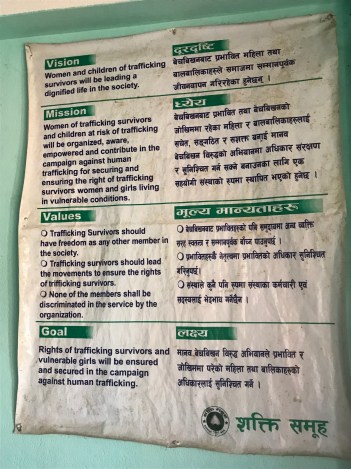
It was at this Safe House where we encountered a giggly woman with a pretty gold nose ring, who I will call Betty, who honored us with her personal story of human trafficking.
Betty’s mother left when she was very young; she hardly remembers her mother. Her dad remarried after her mother left, and he worked in a guesthouse (many guest houses are hush-hush places that accommodate prostitution. Many of the pimps will send the girls straight into people’s rooms, without them even seeking out sex. Tip: If you ever come to Nepal, don’t stay in a place labeled ‘Guest House’). Her father expected her to keep up with all the housework, and she had to do everything before going to school.
Betty was overwhelmed with responsibility from both her home and school life, and she couldn’t keep up with the workload that was put on her. She reiterated the amount of pressure she was put under from both her family and school life, that her 10 year old mind and body simply could not endure. Because of this, she hardly slept, and subsequently would fall asleep anywhere, especially when trying to do her homework. Coming to school without completing her homework would lead to a beating from her teachers. She eventually stopped going to school and moving in with her grandparents, who didn’t treat her much better.
Fed up, she ended up leaving her grandparents’ village home one day, sneakily following her grandfather to on a bus to Kathmandu, where her aunt lived. Upon arrival at the transit center, she recollected never seeing anything so chaotic in her life before. It’s the capital city of Nepal, and the center of all forms of public transportation from all over the country. Think: Times Square in NYC but with no flashing lights and tourists, just dirt roads, street vendors, and people coming and going from all different directions.
She didn’t know it at the time, but the transit center of Kathmandu is also the hub of human trafficking in Nepal. Luckily, or unluckily for her, her aunt lived right by the bus park. She sought “refuge” there for about 3 years (from 10 years old to 13 years), and living in such proximity to the bus park, it was a “norm” to fight off trafficking predators who tease and touch young females inappropriately.
For three years she managed to fight the creepy predators away from her, who only saw her as a body who can make them a profit. But, of course this can be emotionally taxing on a 13 year old girl, on top of running away from a difficult home life, only to be found in another difficult one. Her aunt was not much better to live with than her father was before. She would perpetually call Betty mean names and tell her to get out of her house. But she had nowhere to go.
The only “saving grace” Betty had at her aunt’s was her cousin’s son, who she called a big brother. He’d see her getting scolded by her aunt and he’d often console her and would offer to “help” her get a job, so she could start supporting herself.
One day she finally accepted her “big brother’s” offer, and they went out to get lunch to discuss business. That’s where she got drugged. She had no idea that her “big brother” was a trafficker.
Betty was not in a state of full consciousness when drugged; all she knew was that she had to follow someone. She ended up in India.
There, she met other Nepali girls, and they were all fed very generously and told they get to sing and dance. Her legs and hands were tied and they beat her until she agreed to stay.
Betty only lasted about 9-10 days there, before escaping to find a way back to Nepal. To her actual saving grace, a Christian Indian police officer found her and took her into his home to feed her and truly take care of her. All she wanted was to get back to her native country, so he ended up driving her all the way back to the Nepali border.
From the border, she found a way back to her grandparents home. They were ashamed of what had happened to her, and didn’t want her to tell anyone. Betty wanted to start a case against her trafficker, but they wouldn’t allow it. She knew she would run into him again, and was scared that she would be killed. She noted that if she had had a larger than a 14-year-old girl stature, she would’ve tried to beat him up herself.
The good news is, eventually Betty came across this Safe House for women just like her, and she ended up moving in with the people from the rescue group who started it. She got training in social services, and later got an opportunity to work as a beautician in a five star hotel in Oman.
The reason she originally left the Safe House and got a job abroad was because the Safe House was moving to the city where her trafficker lived, and she didn’t feel ready to be there again. But after several years, she came back, and is now the main woman in charge. She’s using her beautician skills to train other women to gain a new skill for themselves, so they can seek out another type of work. She is happily married and has a son.
Betty said that this was the first time she’s shared her testimony to a group of people in this much detail. She says the things that happened to her seem like a dream, and she will even laugh about it, but can’t deny that it was an extremely difficult time of her life.
The biggest struggle she has now in her position, is seeing so many women come to the Safe House but then end up putting their lives back at risk returning to their old jobs because they don’t know or have any other options to make money and provide for their families. Her mission is to bring down this “entertainment” industry who captures naïve village girls and sends them straight into dance bars.
Hearing the first-hand account of someone being sold into the sex industry was definitely a first for me, and definitely a shock to witness the reality of the situation. It’s not just a statistic, buzzword or hearsay. It’s real, and it’s happening, and so many people are trapped in the trade.
FYI It’s not just women and the sex industry. Men get sucked into becoming traffickers as a means of work, too. Or even become enslaved to sex from the availability and “normalcy” of prostitution. Oh, it doesn’t help that wealthier, neighboring countries are actively exploiting cheap, foreign labor in countries like Nepal.
One of the biggest things I’ve noticed in Nepal are the advertisements around the city. There are a plethora of ads for jobs abroad, especially in Saudi Arabia, Oman, UAE, Qatar, Malaysia, Australia….all over the city. It’s probably the most common billboard/ bus poster ad that I have seen around since getting to Nepal.
Turns out, many of these recruiting companies are contracted by contractors, therefore creating a sort of wall of “legal terms” as a way to “legally” bring migrant workers into their countries. But unbeknownst to the workers, their desperation for work is being exploited for cheap labor, and they get roped into long contracts, and may even get their paperwork/documentation taken away from them, subsequently trapping them into a form of labor slavery.
One of the biggest examples of worker exploitation happening right now is with the construction of the FIFA World Cup stadium in Qatar. Many Nepalis, among other nationalities in need of work, have been recruited as migrant workers to help build the stadium. Most of the demographics are young, healthy men who can endure long, hard hours of construction in the desert. Yet, there are an unnatural amounts of them dying from heart attacks while building this stadium.
For young, healthy men to be dying of heart attacks has to mean they are working under terrible work conditions. Not to mention, that there are over a thousand (recorded) deaths that have occurred since the building of the Qatar stadium; meanwhile, previous stadium constructions, such as Russia, Brazil and South Africa’s death counts were single-digits, or maybe in the low double-digits.
I highly suggest reading this article to read more about the exploitation of migrant workers in the construction of the Qatar World Cup stadium.
Stuff like this may seem shocking to hear, but what I have been realizing is that anything can become “normalized” in a culture when you’re simply surrounded by enough “normal” people who participate in it. In better words that aren’t my own from the article I mentioned above:
“What we see dictates what we think. So [trafficking] is kept out of sight. If the public doesn’t see it for themselves, they don’t have to believe it or can pretend it’s not as bad as it is.”
If you’ve made it this far down my rabbit hole….then you clearly have at least a mustard seed of interest in human rights and the criminal industry of slavery that hides in plain sight. I also suggest reading this article.
“The old way of slavery was that the boss really owned you… But now legal recruiters and employers work in tandem to deceive workers who, vulnerable and isolated in a strange culture, are forced to accept harsh terms. It is in that context that you have endemic forced labor today.”
Not to burst yet another bubble, but this type of trafficking happens not only in poor, third-world countries, like Nepal. It’s happening right in your backyard, and maybe even under your own nose.
Craving some culture shock? Why not do some research about your own city. I was shocked to hear that San Diego is one of the biggest human trafficking locations in the US. Not exactly the first thought you have about “America’s Finest City”. Digging beneath the surface, you may find some interesting things about your own turf that you may have thought only happened in “dangerous” countries. Or you can just ignore everything you’ve just read and move on. Your choice!

 Candor Collective
Leave a reply to CHILDREN – Candor Collective Cancel reply