
This Thanksgiving weekend I was planning to drive up to LA for a nice American holiday break, but the caravan at the border from Honduras put a wrench in my plans. It’s been a hot topic in news headlines, and I think this may be the first time in my life (since 9/11) that a major political event like this had a tangible effect on my life. Not a big one – I still got to eat turkey and stuffing on Thanksgiving, so nothing life-altering, don’t you worry.
My immediate reaction to the situation was a selfish one: I wouldn’t get to see my friend and spend a nice holiday with her and her family. But I quickly realized that this opened up an opportunity to actually get involved in this humanitarian crisis that was directly in my path.
A group of us who stayed behind at the base for the holiday weekend gathered and headed to the caravan site the day after a bountiful Thanksgiving. I had a really great holiday with an abundance of food, laughter and fun. But, I have to admit in the back of my mind as I was getting up for seconds for dinner, I was imagining families sleeping on the streets and scrambling for food and shelter.
We didn’t bring anything with us to the caravan site. We had heard that when there were handouts of food or clothing, aggression and violence would erupt due to “every man for himself mentality”. Our intention was to get a closer look at the situation, talk to people, lend a listening ear, and offer prayer for them if they so desired.
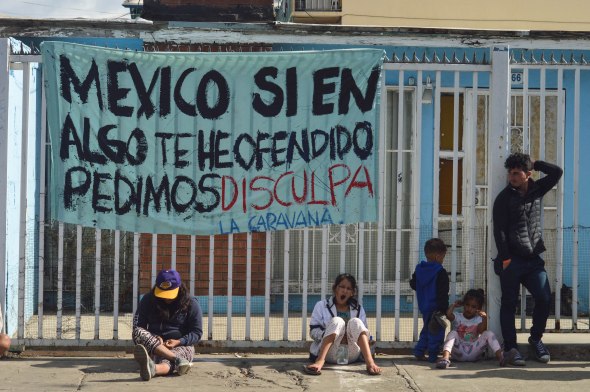
Upon arriving to the site, I was surprised to see how many photographers and news reporters were there just swarming around like flies. There were also tents set up for health inspections/disease prevention, and some food stands. People were lingering outside the campsite area, which is where we remained because we didn’t think it would be smart to just walk into their camp area.
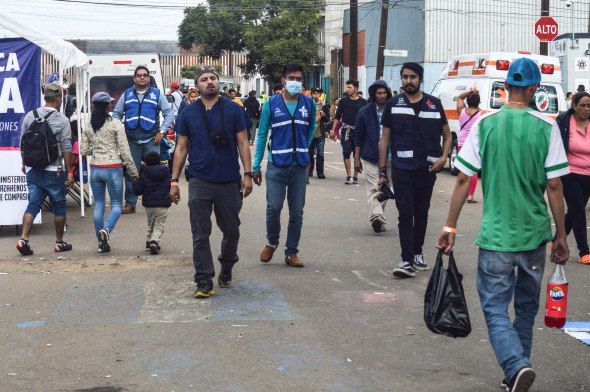
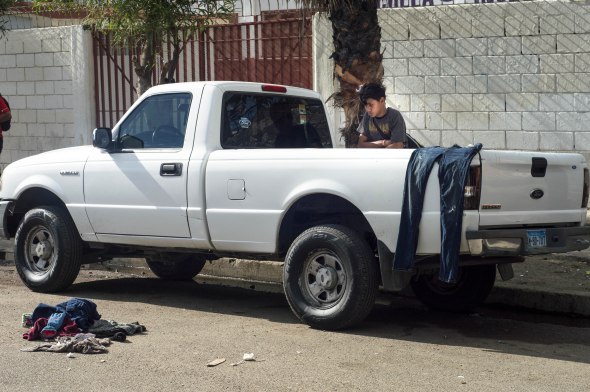
The first woman we talked to was a woman named Moira who came here with her children, along with her sister and her family. She came in a group of 11 people total who migrated from Honduras through Mexico over the span of 30 days on foot, and by car. I asked why she came all the way here, and she simply said for work. There are no job opportunities back in Honduras, so her and her family put their hopes in providing a better life for their children by coming to the U.S. for jobs.
She explained how right now, they are simply stuck at the encampment near the border in Tijuana. They cannot go back to Honduras, because they left everything behind, and there’s simply no hope in sustainable job opportunities to create a life there. They aren’t being let into the U.S for obvious reasons, and Mexico doesn’t want them there either. So they just have to stay where they are and wait for some sort of government response: jobless, tentless and moneyless in a closed off street/park area. I could see the tiredness and desperation in her eyes. But her, like everyone else we talked to, still hold a hope in making it into the U.S. at some point.
Being an American and knowing the controversial nature of this situation, I didn’t want to offer any hope in the American government for solving her and her family’s problems. But I still wanted to hear her story and just show that people care, despite not being able to be an answer to her problems.
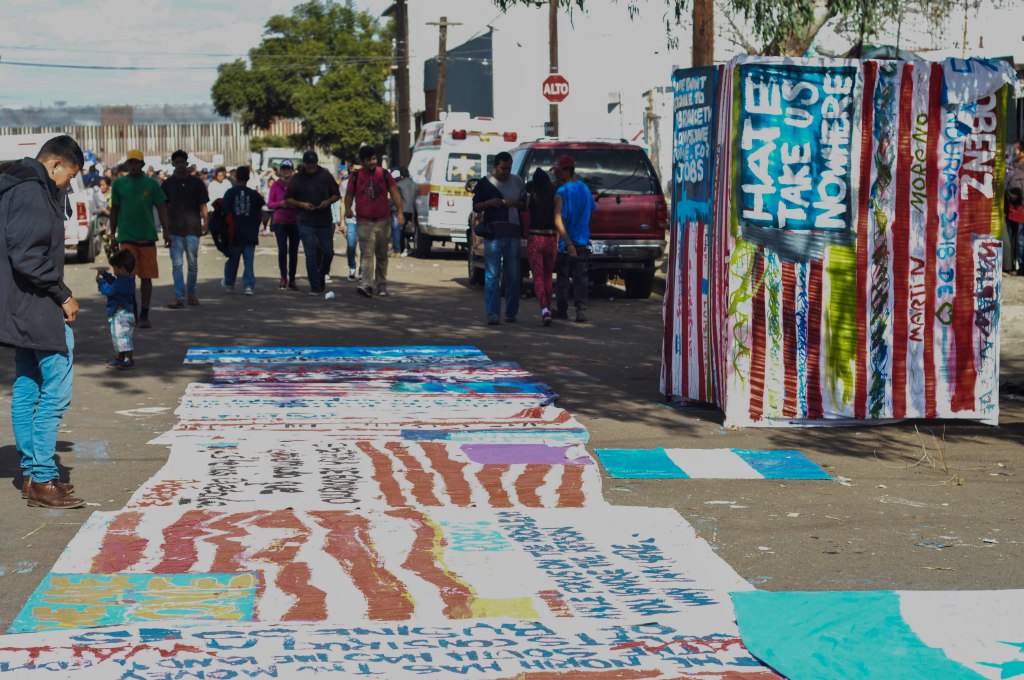
Another man we got to talk to was standing behind a tent that was being painted like an American flag with different messages on each side. The front said: “We don’t come to break the laws, we come for jobs”; “God over all things” on one side, and then “Hate takes us nowhere” on the other side. Having so many photographers and reporters there, a way for them to get their messages across was by utilizing art, which I thought was kind of cool how valuable artwork can really be in political climates.
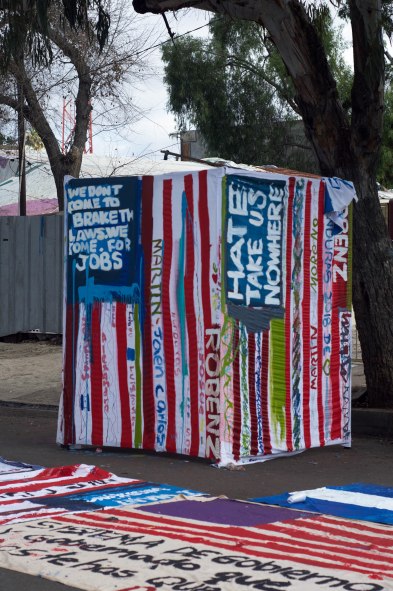
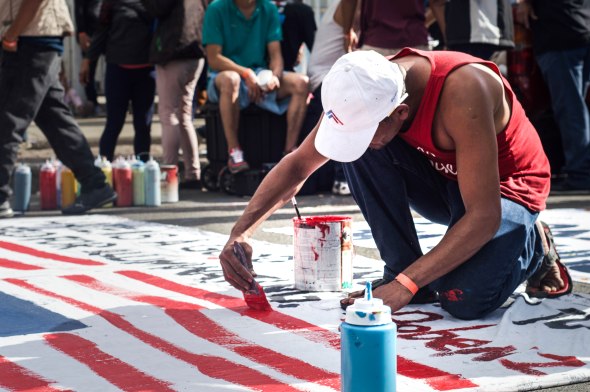
I don’t remember this guy’s name, but he had a lot to say and many political opinions, to the point where he talked so fast that some of it was lost in translation. But I thought it was interesting that as he was speaking, more and more people started to gather around and listen to him and join the conversation. It got to the point where a videographer got in there and started filming the conversation, as well.
He went off, not complaining about how the American government isn’t letting them in, but explaining the corruption of the Honduran government, and how the biggest problem with living there is a lack of resources. I asked if a lack of education was an issue, as well, and he said no. People who get educated and try to move up to an office job for a “better” life, end up not being able to find work, because the buildings don’t have electricity, for example. That was very interesting for me to hear, because a lot of times I have assumed issues in poorer countries could be solved with better education, but in this case, education is somewhat invaluable because there still aren’t the resources to create opportunities to utilize the education received.
I asked him, “If there was one thing you could tell American people, what would it be?” His response was again, not a complaint about the help they aren’t receiving, but actually acknowledging the help small countries like Honduras receive from large countries like the U.S. However, all the resources and assistance given to them is hardly ever seen by the actual citizens. Nothing is improved, because their government is getting ahold of everything and keeping it for themselves. He did go on to complain about how their government doesn’t care for their people. And again, how his hopes are in getting across the border to the United States for the opportunity to work.
Hearing personal stories and different perspectives is always so much more eye-opening than a generalized news report, in my opinion. Calling them a “caravan of immigrants” is much less humanizing and easily can be portrayed as demonizing. But hearing only a few people’s stories allows our hearts to be opened to a human worldview, which goes beyond political standpoints.
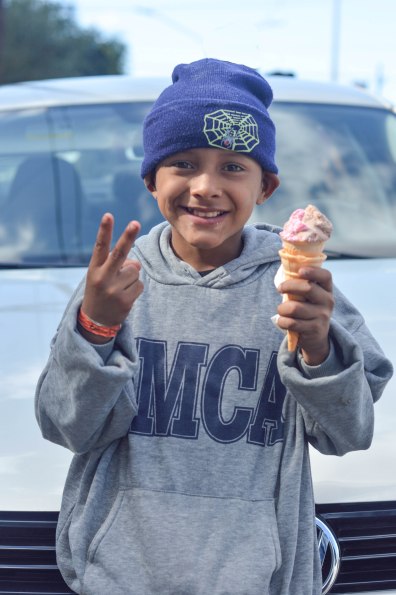
We didn’t get to choose where we were born. What if I was born in Honduras? This could’ve been me and my family in an alternate reality. At one point, pretty much all our families (if you are living in the U.S.) migrated to America for a better life, whether it was one generation ago or 8. What if they never made it? Our lives would be drastically different than they are today.
Last week in class, we heard some statistics on “If the world were 100 people” and it really changed my perspective on my position and power I have in this world. Some of the ones that really stood out to me are these:
If the world were 100 people….
- 23 people have no shelter from wind/rain
- 16 people have no toilets
- 13 have no access to clean, safe water
- 22 have no access to electricity
- 24 males, and 28 females have no primary education
- 12 males, and 21 females aren’t able to read and write
- 7 people have a college degree
- 30 are active internet users
- 22 own or share a computer
- 20 people live in fear of death by armed attacks, land-mines, bombardment or rape/kidnapping by armed groups
These are the ones that really got me:
- If you have food, clothes, a roof, and a bed, you are richer than 75% of the people in this world.
- If you have a bank account, some money in your wallet, or cash in a box, then you belong to the 8% of the rich in the world.
Again, it just makes me think, why did I get lucky enough to be a part of the top 8% in this world? It really invokes a sense of responsibility in the education and resources that I have had access to. How am I going to use them? Should I keep it all for myself, or do I have some sort of accountability to share it with those who don’t have access to the things I do?
What all of this boils down to is opportunity. I have been born into a family and a country that offers me so many opportunities that it is overwhelming. So many possibilities that I could choose from that I experienced a “quarter-life crisis” due to the fear of choosing the “wrong” path. I didn’t have to fight for it, it was just the world I was born into.
I don’t know if us as Americans (and other 8%ers) truly realize the power we individually hold to influence the rest of the world. I don’t have the answer to this caravan conundrum, or the unequal distribution of resources, education and money in the world, but it sure does make me think about who I am from a global perspective. I truly believe that I have the responsibility to use the opportunities, education and resources that I have been blessed with to somehow become a part of the solution to helping those who don’t have access to the same. And I know anyone reading this holds the power within themselves to do the same. Think about it!

 Candor Collective
Leave a reply to CORNERED – Candor Collective Cancel reply