
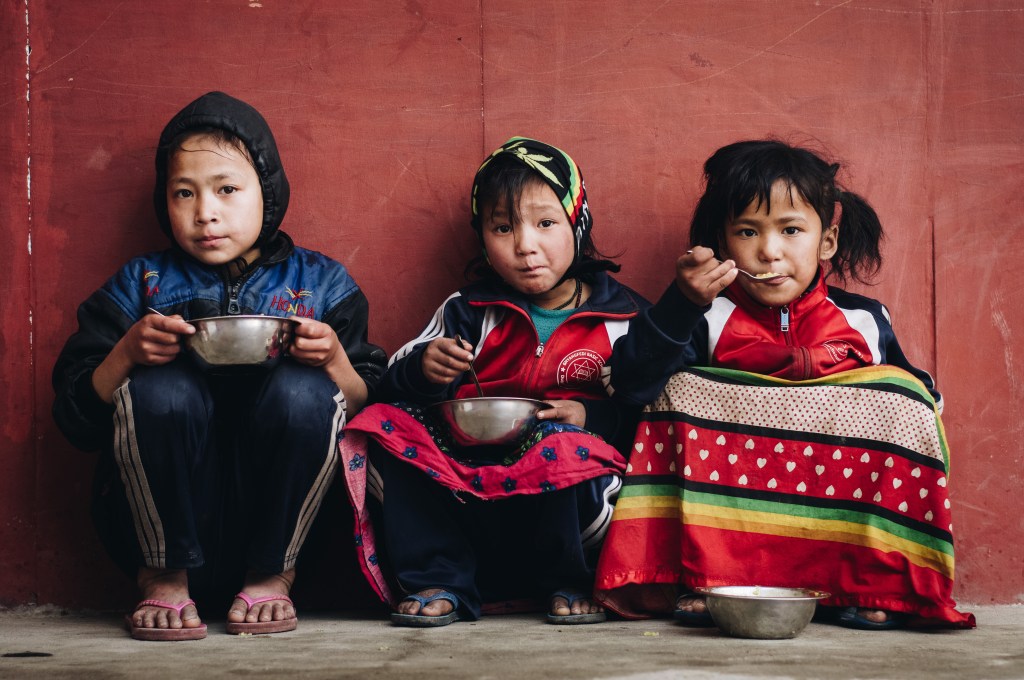
I have been terrible at keeping up with blog posts since my travels to Nepal and Guatemala, but I wanted to write about a common denominator in both of these places that has given me both sadness and joy; disappointment and hope; anger and excitement. This has been from observing and interacting with children.
The past several years of my adult life have been pretty self-focused and mostly centered around other twenty-somethings in the same life stage as me. I grew up around lots of kids, but now that my siblings and I are all adults, I haven’t had much interaction with children, ever since teaching English to five-year-olds in Barcelona in 2015-16.
Nepal is the further place I have ever been from home, and with a culture so vastly different from my native one, so is the language. The only word I already knew was “namaste”, so obviously over-used it in attempt to communicate with people as much as I could. Luckily, in Kathmandu many people spoke English, but once we went to villages, we were pretty much screwed for communication with people without a translator. Or so I thought.
I started to notice there are more ways than oral language to communicate with people. The excuse of a language barrier to bar you from interacting with those who can’t speak your language is exactly that: an excuse. I came to this realization when I saw how we could interact with Nepali children and be able to have a connection and relationship with them, despite having hardly any verbal communication among each other. Even kids from your own country can’t speak in the early stages, yet you can still form a relationship with them.
Upon interacting with children in Nepali villages, I realized that this communicated something non-verbally to the parents, as well. This stranger cares about my child and wants to engage with them – I want to interact with this person, too. Playing and interacting with children in Nepal was like a bridge into connecting with the parents, as well. It didn’t matter about our native tongues, the language of love and care speaks for itself.
Despite seeing how children can be a bridge into communication with parents, what really struck me was how incredibly the same children are no matter where they are from in the world. Curious, shy, adventurous, creative, sometimes overly-aggressive, playful, innocent.
Innocent. I think that’s why I was so amazed by them. Their innocence is what really struck me and was a contrast to some of the heavy duty corruption and injustices I have learned and been learning about different parts of the world. And even just being surrounded by adults for so long, I forgot what innocence even looks like, and it was like a breath of fresh air.
What appears to makes us adults feel so different from one another, especially from other countries, is that our external circumstances don’t look the same. Our worlds- people, places, experiences- shape us in different ways, and over time we lose sight of our inherent sameness to one another. We start to define ourselves by our exterior worlds, instead of internal.
For example: all kids love to play. How they choose to play, will depend on their surroundings. A little kid from Nepal who grows up in the rice fields in the mountains may choose to use sticks from the ground as pogo-poles to hop around from tier to tier on their land (yes, this is a true story). Me, a suburban Jersey-girl, grew up choosing to play with Barbie dolls because I could collect them and style and dress her the way I saw fit (no pun intended). The Nepali boy will probably grow up knowing all the lays of the land and how to cultivate the rice fields in an empirical way that couldn’t even be found in a book (or “How-to” google search, for those of us Millennials). Me, the Jersey girl, grew up to study fashion merchandising and learn all about the things people want to buy, and ways that people shop. Something that Nepali child probably will never have any use for.
All I know is that kids are like sponges and absorb everything around them: conscious and unconscious things. Of course, genetics play a part as well, but I’m not getting into all that sciencey stuff. I just have my social and cultural observations and inherent knowledge on being a human.
Many of the cultural differences I noticed in children were things I truly admired. Like, how some kids would walk 2 hours in the mountains to get to school one way, and were excited to go to school. Meanwhile, I had a 10 minute walk to my elementary school and I thought it was the end of the world when my mom couldn’t pick me up in her mini-van.
Helping out in a Nepali day-care center, I noticed how the kids (1-3 years old) all share their toys without fighting or staking claims on their personal property. My sister and I had to have separate Barbie dolls because sharing would cause too many fights.
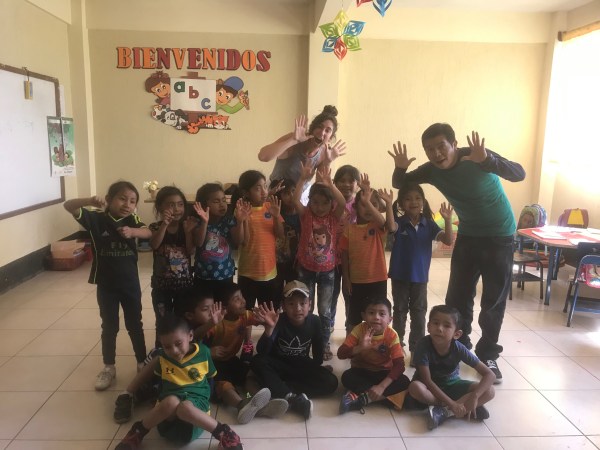
I spontaneously walked into a Guatemalan school with a random lady with no prior planning, and was greeted by the children with group hugs and hand-holding, and an open door invitation from the teacher to come back and visit any time. Meanwhile, unfortunately in the United States teachers have to have gun threat drills to prepare for a potential shooter in the building.
There were also some cultural differences that truly saddened me. One of them being the child goddess in Nepal, called Kumari. It is believed that the spirit of the goddess, Taleju, lives in a female child. In order to figure out which girl the goddess is living in, there are several rituals and physical requirements that the girl must “pass” in order to be qualified as the living goddess. The biggest test is that the girl must spend the night in a room filled with dead animal heads. She is not allowed to cry; if she cries then the goddess cannot be living in her. Biologically, when a child is frozen, eyes glazed, not crying, it’s because she is actually traumatized and in shock, however it is seen as a testament that Taleju is living in her.
Once the girl is chosen, she must leave her family and live in a palace where people come to worship her from beneath her window. She cannot ever touch the floor outside the palace, and can only go outside of the palace a few times a year. Once the girl gets her period, it is believed that Taleju then leaves that girls’ body and moves onto another, and the government gives the girl money but must leave the palace. Unfortunately, if she remains in her home country to be with her family, she can’t ever get married because it’s seen as bad luck for a man to marry her. Some ex-Kumaris choose to move away to other countries, and live estranged lives, and others simply accept it as part of their life and their cultural traditions. Read an interview of an ex-Kumari here.
The prevalence of the sex trafficking industry in Nepal also deeply saddened me to hear how many young girls are being captured, or even sold by their families for money. I know that this practice is something found not only in Nepal, but all over the world. But to me, the saddest part is that as they get older, many of them choose to stay in the industry, because it’s all they know and their only form of income.
In Guatemala there isn’t a culture of sex slavery, but there’s a Narco culture that ropes children in from a young age. Sometimes it’s forced, and other times it’s a grooming. But once they’re in the trade, there’s not many ways to get out, other than death, being locked up in American prison, paying millions for complete facial reconstructive surgery, or a miracle by God.
I saw a young boy, maybe 4-5 years old, wandering around the Guatemala City center all alone for awhile. He didn’t look sad or depressed; he looked like he was having fun chasing pigeons around and sitting in the middle of a fountain where you weren’t supposed to be. I was curious about him – why was he alone, and why didn’t anyone else seem to notice? Upon asking my local friend about it, he said he’s probably a “lookout”. Meaning, this child’s innocence is being exploited to do the dirty work of a power-hungry and manipulative group, that has a grip on the entire nation of Guatemala (and others). If this child messes up or rats them out, they kill him: simple!
These harsh realities about children have been hard pills for me to swallow, since my exposure to them. How quickly some children’s innocence can be taken from them, from a vicious cycle of exploitation and corruption in society. I was lucky enough to have a childhood shielded from these realities, but many children aren’t. And these problems are found globally; even in our own towns.
To me, the most angering, disappointing, and sad aspect of children growing up in corrupt cultures is the normalization of it all. And anyone can fall susceptible to this strangely amazing phenomenon of the human psyche. Whatever you grow up around as a child, becomes your sense of “normal”. That is the grave danger of children being exposed to such perversion at young ages. The cycle gets harder and harder to be broken.
I am going to stop going down the depressing train, and close with a sense scenario of humor and hope. That culture is just like the clothes we wear. If everyone around us is wearing the same thing that we are, we can justify it as the standard of normal. But when you go somewhere else, expecting the standard of normal to be the same, you may be pleasantly, or unpleasantly surprised, depending on your personality. But, if no one ever wore clothes (or we all wore potato sacks, for some of you with dirty minds), then what’s really separating us from each other? What makes us different?
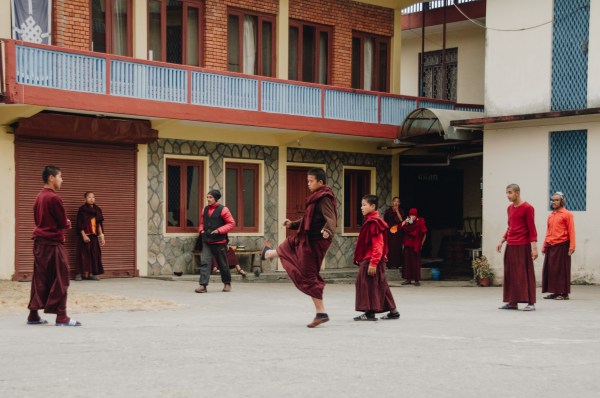
Sitting in a Buddhist monk temple, I observed these boys in their long, simplistic red robes pull sneaky pranks on each other during the time they were supposed to be doing their rituals and mantras. And then kick around a hacky-sack outside. From a distance, it would appear that they’re some ultra wise, calm, peaceful 12 year old boys. But, parents, I tell you that sending your kid to become a Buddhist monk in Nepal will not take out their innate nature of being a boy. Boys will be boys, is a cliché phrase for a reason.
At the end of the day, we all started out as children, yet I think we too easily forget what it’s like to be child-like. I think we could ease up on teaching kids how to be like us adults, and instead start learning more from children on how we can become more ourselves. They are a reminder of what humanity is before culture and other influences take ahold. Why is it that the word innocence is seemingly synonymous with “child”? Why is it as we get older that we completely lose sight of the meaning of innocence? Does that mean that all adults are the opposite of innocent, meaning corrupt and guilty? How can we as adults restore a sense of innocence in this world that’s not exclusive to children?
 Candor Collective
Leave a comment